
The Red Kettle That Became a Star in Yasujiro Ozu’s Films
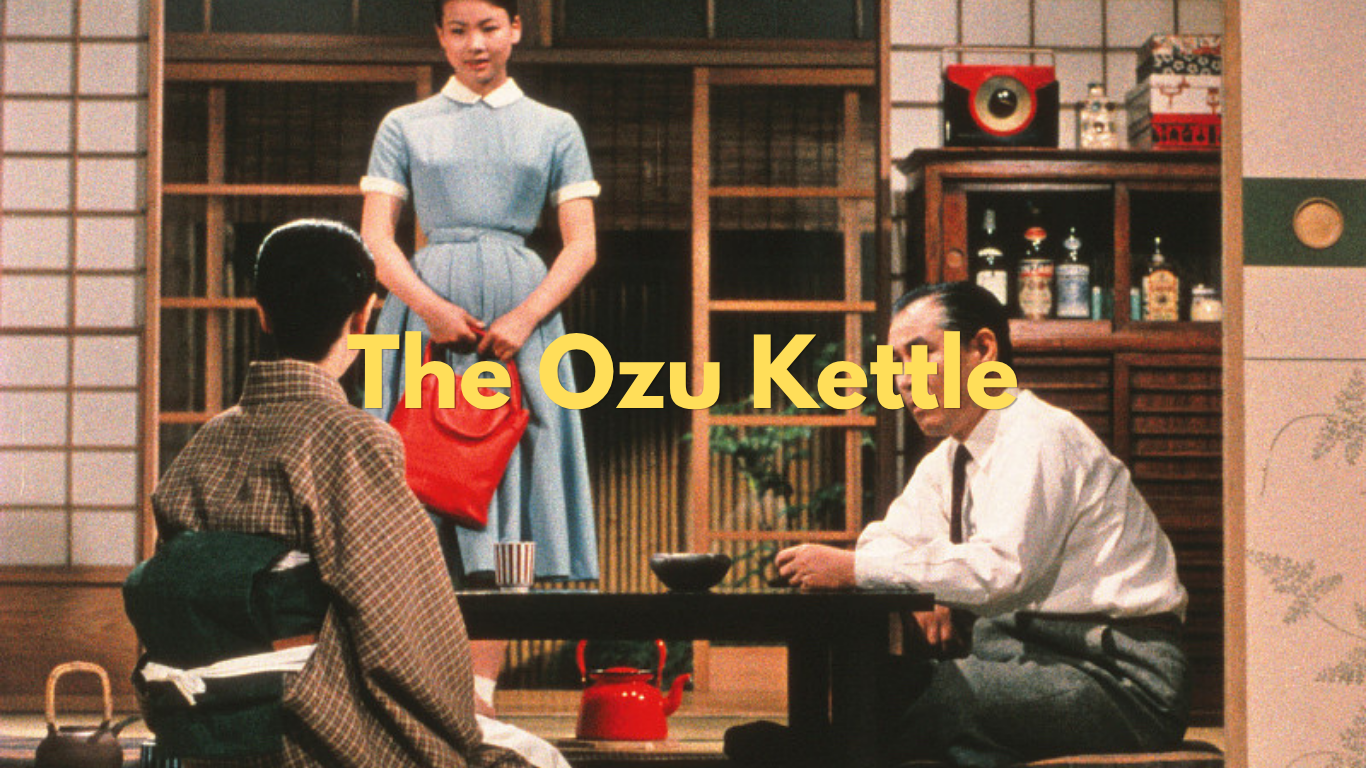
The red kettle featured in Ozu’s film Equinox Flower
The Story of Yasujirō Ozu’s Red Kettle
In 1958, Yasujirō Ozu made his first color film, Equinox Flower. For a director already known for the extraordinary precision of his compositions, the move from black and white was not simply a technical upgrade. Color became another tool Ozu could use to organize space, guide the viewer’s eye and give everyday objects a presence equal to that of his actors.
No color became more closely associated with Ozu’s late period than red.
Ozu’s First Film in Color
Ozu adopted color relatively late in his career, several years after Japanese filmmakers had begun experimenting with it. When he finally made the transition, he approached color with characteristic restraint.
Rather than filling the screen with as many colors as possible, Ozu preferred a carefully controlled palette.
For Equinox Flower, Ozu chose Agfacolor film stock, which was known for reproducing deep, saturated reds. Red was reportedly Ozu’s favorite color, and the Japanese title of the film, Higanbana, refers to the vivid red spider lily that blooms around the autumn equinox.
Throughout the film, red appears in flowers, clothing, carpets, signs, lampshades and household objects. These flashes of color punctuate Ozu’s otherwise restrained interiors, creating a visual rhythm among the horizontal and vertical lines of doors, screens and furniture.
Among these objects, one became especially memorable: the small red enamel kettle.
The Ozu Kettle
The “Ozu Kettle” was an enamel kettle produced by the Swedish company Kockums. Its rounded shape and bright vermilion finish made it an ideal accent within Ozu’s carefully arranged domestic interiors.
During preparation for Equinox Flower, Ozu personally went out and selected the kettle . After filming ended, he took it home and continued to use it in his own household.
This was typical of Ozu’s approach to props. The objects in his films were rarely treated as anonymous background decoration. Research published by the Japanese Society for Representation Studies notes that Ozu sometimes sourced household goods and artworks through dealers he knew personally.
A kettle, vase or bottle could be as important to the composition as the characters seated around it.
The “Teleporting Kettle”
The kettle later acquired the affectionate nickname of the “teleporting kettle” because its position did not always follow the rules of conventional cinematic continuity.
In Ozu’s films, an object might appear in one position during a wide shot and then move somewhere else when the camera angle changed, even though no character had touched it. In a bold statement that composition took priority over simple continuity, Ozu was willing to rearrange props between shots when doing so produced a stronger composition.
The red kettle could sit prominently in the foreground, balancing a character or architectural feature on the opposite side of the screen. In the following shot, it might appear in another part of the room entirely.
Film critic Roger Ebert observed that Ozu often used noticeable foreground objects to help viewers understand his unconventional camera reversals. The kettle therefore served several purposes at once: it was an ordinary household utensil, a bold red accent and a visual anchor that helped organize the space.
The red Kockums kettle is most closely associated with Equinox Flower, while a green version of the same design appears in Ozu’s 1959 comedy Good Morning. Similar flashes of red continued to appear throughout his remaining color films, including his final feature, An Autumn Afternoon, released in 1962.
Why Red Mattered to Ozu
It can be tempting to search for one symbolic meaning behind every red object in Ozu’s films. Masterfully using red to visually disrupt the frame, the color takes on a weight as a force of change, particularly in Equinox Flower, a story about a traditional father struggling to accept his daughter’s independence.
But Ozu’s use of red was not simply symbolic.
Red directed the viewer’s attention. It balanced the geometry of a room, enlivened a neutral interior or created a connection between separate areas of the frame. A kettle, thermos flask or sign could become the visual anchor of an entire scene.
This was central to Ozu’s filmmaking. Rooms did not merely contain his characters. Furniture, architecture and household objects participated in the film and served to externalize the emotional tone of the scene.
A person might leave the frame, but Ozu’s camera often remained behind with the empty room, forcing the viewer to reflect on the lingering remnants of what just happened, while looking at the kettle, vase or bottle that had quietly helped shape the scene.
The red kettle became something like a member of Ozu’s repertory company: silent, familiar and always placed exactly where the director needed it, even when it had to “teleport” to get there.
The Ozu Kettle Club Tie
The Ozu Kettle Club Tie was inspired by this small but unforgettable object from Ozu’s films.
Its repeating kettle motif transforms Ozu’s famous red accent into a classic Ivy-style club tie, made in Japan from pure silk woven in Kyoto. Like the original kettle, it is an everyday object made memorable through color, repetition and careful placement.